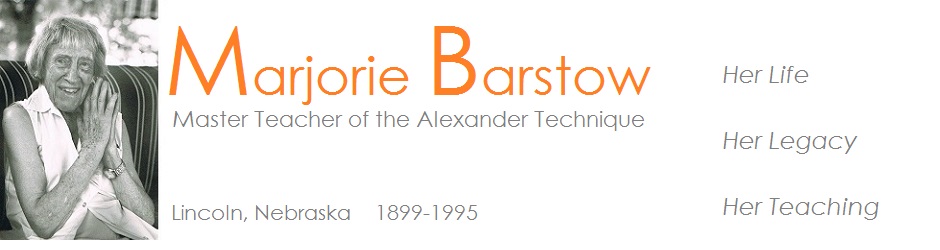
Taken from: Aphorisms of Marjorie Barstow – Collected by Marion Miller and Jeremy Chance originally published in Direction Journal
The ‘magic’, if you want to call it magic, is your constructive thinking.
I don’t work on the table. I think the Alexander Technique is about movement. I like to work with my pupils in their daily activities… I don’t believe in giving lessons in silence because I want to know what my pupils are thinking. I am not making a mechanical person out of them: I want my student to know what I’m doing; know how they experience it; talk it over with them.
CONSTRUCTIVE CONSCIOUS CONTROL…
CONSTRUCTIVE: because we are changing something in ourselves
which is ineffective, harmful.
CONSCIOUS: because we become aware of what we are doing.
CONTROL: because we are redirecting energy and bringing freedom into the whole mechanism.
Our voices are talking to your thinking apparatus;
our hands are talking to your sense of feeling.
You don’t want to reproduce the feeling but the mental process.
Learn to laugh at yourselves: you always move better with a smile.
All you want is a little bit of nothing–but the trouble with all you people
is that you all want something. And that something is your habit.
Inhibition is the activity by which the old habit cannot take place.
You stopped that constructive thinking that wouldn’t have allowed
the habit to take place.
All you’ll get is the absence of what you had.
It is the delicacy of the movement that will give you your release.
When I find myself pushing, I have not taken the time to see where I am
before I start to move.
You didn’t recognise that you could move without the tension
you usually associated with forward and up.
If you memorise your feeling you’ll never change.
When I help her she relies on her feeling,
because then her feelings are freedom and ease.
I am not making a mechanical person out of them:
I want my students to know what I am doing;
know how they experience it; talk it over with them.
Nothing will move if you don’t engage their mind.
Once the pupil sees it for himself, he can make the change without any trouble.
You have to do the brainwork.
How we get ourselves into this mess I don’t know;
but this is a way to get out.
He was scared as he was keeping his mind on what was bothering him,
instead of looking for what to change.
Emotions are a part of your mental activity.
What are you waiting for?
You’re setting your head and waiting to get a right position.
Forget all that, it belongs to the past. As soon as you get a good experience, instead of using it,
you say “Oh–I usually do this and this and this.” And the new experience just washes away.
So you are learning less and less about your self,
and more and more about what is possible.
You’d better talk about a ‘preventing’,
because if you talk about a ‘keeping’, you will stiffen.
When you give up–doesn’t that mean you were looking for a position?
The only time I fussed with you about feeling
is when you set yourself to feel right.
I don’t let you take all that time before you start because you’re trying to feel you’re right and that’s endgaining.
It’s only if she starts pulling down that her attention
needs to go to her head and neck.
There is no right place, there is just a little bit more ease.
Pupil: “My feelings are confused.”
Marj: “So long as your thinking isn’t confused, you’re OK.”
I don’t know why you are pushing there?
You’ve got some kind of idea–let’s see what your idea is.
You just start helping them from where they are and where their thinking is.
The people who are the most difficult to help are the ones who won’t talk.
Spend a little time in conversation finding out what the person is learning…
Pupil: “I move my head but I’m not sure.”
Marj: “You’re never sure. You move your head and you see what happens.”
Pupil: “I’m going to move my head and not pull down.”
Marj: “You let that little word ‘not’ slip in and your habit slips in.
Say instead ‘I’m going to move my head and see what happens’
and carry on your constructive thinking through the act.”
Marj: “Why aren’t you moving?”
Pupil: “I thought about not stopping my head.”
Marj: “There’s that negative thought–that’s why you stiffened.
That’s why I let you talk–you give yourselves away.”
You’ve got so many “nots” you’ll never undo yourself!
The head tilts a little as it moves up–I don’t know myself if the tilt forward moves the head up
or if the upward movement tilts the head forward?
You do have the experience that as you let your head move and body follow, your habits cannot take over.
Even those positions of mechanical advantage are movements.
I’m not interested in little pieces of tension–
it’s my whole head and my whole body.
She let her feeling decide instead of her thinking.
When you don’t feel some stiffening or pressure, you don’t know what to do.
He creates a feeling which stiffens the direction.
He puts the mental state at the end of the process–that’s upside down.
Your sensory mechanism becomes more and more reliable
but you trust your thinking first.
Thinking and moving are the same thing–don’t wait for perfection.
Maybe he was pulling his head back a little–but he got a little improvement.
You are not supposed to expect something–
you are supposed to be experimenting.
You can’t tell until you move it. You move it, then you feel it–and that’s what you notice. When you fix it–you’ve lost it.
I’m so practical, I shouldn’t be living!
I don’t want you to have a picture–I want you to know you’re doing it.
People love complicated things–but this is so simple, people think it’s hard.
It’s so simple it’s shocking.
She let her feeling decide instead of her thinking.
He puts the mental state at the end of the process – that’s upside down.
You can’t tell until you move it. You move it, then you feel it – and that’s what you notice.
He creates a feeling which stiffens the direction.
The only time I fussed with you about feeling is when you set yourself to feel right.
Thinking and moving are the same thing – don’t wait for perfection.
Pupil: “I move my head, but I’m not sure.”
Marj: “You’re never sure. You move your head, and you see what happens.

This photo of aphorism given to me by Marjorie around 1984. She wrote it on the back of a check. I used to walk by her house when I was going to architecture school in Lincoln and one day a friend of mine was on her porch and called me to come up and meet Marjorie. I also met her sister who was still living at the time. I was very much interested also in the history of her house, her family, and her life on that corner in Lincoln. I think she was still horseback riding at the time. I attended a few of her classes but soon left Lincoln for my present home in Maine. I kept the aphorism all these years because I cherished the few meetings I had with her. I often think of her when I am out walking. – Steven Pondelis
Many more aphorisms:
Marion Miller kindly gave Jeremy Chance and Peter Jacobson access to her notebook, where she had written down many of the aphorisms from Marj that Jeremy printed in DIRECTION and that can be found above. However, Jeremy originally used only a selection. There are many more.
Jeremy and Peter scanned the book, then asked AI to transcribe them all:
Source: Marion Miller’s Student Journal — many years studying the Alexander Technique with Marjory ‘Marj’ Barstow
Transcription note: This document extracts all legible handwritten aphorisms from a 37-page scanned journal. Three categories are used: CONFIDENT (clear, high-confidence transcription); UNCERTAIN (readable but one or more words may be wrong, flagged with [?] or explanatory notes); and ILLEGIBLE (ghost/faint text that could not be reliably extracted).
SECTION 1 — CONFIDENT TRANSCRIPTIONS (177 entries)
The following aphorisms were clearly legible in the handwritten original and are transcribed with confidence.
[p.2] You cut off the air before you started to sing, by this little downward movement of your head.
[p.2] We don’t know anything about ease of movement.
[p.2] Your eyes and your thinking must go together.
[p.3] It’s only if she starts pulling down that her attention needs to go up to her head and neck.
[p.3] You can’t use gravity as an excuse.
[p.3] You are wanting to be right, but we’re not talking about ‘right’ — we are talking about moving.
[p.3] The thing that I’m talking about is very elusive — it’s never going to feel the same twice.
[p.3] Three-quarters of the time when you lose your balance, it is because you have stiffened your neck.
[p.3] What did you notice on your first step?
[p.3] How we get ourselves into this mess I don’t know, but this is a way to get out.
[p.3] If you’re not careful when I suggest forward and up, there will be a slight downward pressure or stiffening up.
[p.3] ‘I’m still doing something with my shoulders and neck.’ — ‘Well, move your head, then.’
[p.4] It’s getting easier — that’s what we want to watch.
[p.4] To carry your constructive thinking into activity.
[p.4] This delicacy of movement as the basis of performance.
[p.4] A new area of movement — a quality of energy that is delicate, where our own natural flexibility has a chance to operate.
[p.4] Lying down work — what they do with it when they get up and onto their feet.
[p.4] It’s not your triceps, it’s your whole body — forget about that.
[p.4] Without the tension — your feelings tell you you’re not going to achieve the result in your arms and shoulders.
[p.4] The breathing apparatus is not controlled by individual muscles but by the coordination of the whole organism.
[p.5] Your back in your old habits after your fourth step. You are all end-gaining — get lazy — you think you’ve got it and you lose it.
[p.5] If you hold your chest, there’s just one way to go — down.
[p.5] When you go back past a vertical, your body keeps its balance with this forward tilt — not very much, just enough to prevent that backward downward pressure.
[p.5] I just want you to see how little this movement of the head (tilt) is.
[p.5] What are you waiting for? You’re setting your head and waiting to get a right position.
[p.6] Forget all that — it belongs to the past. As soon as you get a good experience, instead of using it, you say ‘Oh but I usually do this and this and this’ and the new experience just washes away.
[p.6] When you catch yourself doing all of these funny things, you just do your constructive thinking and start to move.
[p.6] He was scared as he was keeping his mind on what was bothering him instead of looking for what to change.
[p.6] You don’t think about it, you just move it.
[p.6] If you memorize the feeling you’ll never change.
[p.6] You were ordering but you didn’t turn the ordering into an activity.
[p.7] The movement of the body happens at the same time as the head. The forward and up acts as a lead in every activity.
[p.7] And continue with your movement. When you stop in the middle of a movement, that’s what Alexander called ‘physical stuttering’.
[p.7] When you give up — doesn’t that mean you were looking for a position?
[p.7] You’d better talk about a ‘preventing’, because if you talk about a ‘keeping’ you will stiffen.
[p.7] Your neck was stiff, your chest was set — you had no chance of moving anywhere.
[p.7] First the movement — the experience comes as you think in movement.
[p.7] Until you carry out this little procedure, you will not know what Alexander’s directions are about, because you will not have had the experience of the discovery of the free release of the head to move. You can talk about it but you won’t know it.
[p.7] What are you waiting for? You’re setting your head and waiting to get a right position.
[p.7] If you memorize the feeling you’ll never change.
[p.7] Your sensing a different quality of movement — if you sense it, it’s already there. If you try to hold on to it, it’s not.
[p.8] I don’t know what it means to think internally.
[p.8] Bates exercises can do a lot of good, but your own coordination makes the difference to the good you get out of it.
[p.9] The only time I fussed with you about feeling is when you set yourself to feel right.
[p.9] Extending arms — not too far until you get your balance and comfort, then if you want more extension you can add it after.
[p.9] If you don’t put the tension here — the ease here allows you to move as your hands go to the piano — this will move.
[p.10] The teacher helps you recognize where your coordination is at the moment. Decide if it is useful. If not — apply constructive thinking. Then see what happens — unknown.
[p.10] You see where you want to make a change, that requires movement — what moves first? Head, then body, all together, one after another.
[p.10] Widening the back is releasing the downward pressure throughout your body, so your ribs and respiration can move.
[p.10] Teaching — you put your hands on to find out what the pupils are doing. The first impression is the most important (to them) — of your hands.
[p.10] If you do this, nothing with your body — you’re not doing nothing, you’re doing something.
[p.10] That delicacy I’m talking about is your constructive thinking.
[p.10] There is a lot of space for movement between that downward pull and the upward push. That’s the space that Alexander was talking about.
[p.10] The ‘magic’, if you want to call it magic, is your constructive thinking.
[p.11] I don’t let you take all that time before you start because you’re trying to feel you’re right, and that’s end-gaining.
[p.12] 1. What moves first. 2. Direction of movement. 3. Quality of movement. You don’t know what to expect.
[p.12] It’s not the distance, it’s the quality of ease.
[p.12] I don’t call that an image — I call that watching what is actually happening.
[p.12] When I find myself pushing, I have not taken the time to see where I am before I start to move.
[p.13] What do you notice.
[p.13] As you lie down — constructive thinking.
[p.13] …begins to interfere a tiny bit with the greatest efficiency of circulation and respiration.
[p.14] Every time I take my hand away, where do you go? Back. This pressure sets your respiratory mechanism.
[p.14] No, you’re not stagnant — you’re pulling down.
[p.14] I feel the tension but I know it’s not from your hands, it’s from me, so I move up to lessen the pressure.
[p.14] My moving you around is not going to help you when you leave this room. The manner in which you take the responsibility. My hands are a guide — it allows you to gain a great deal of confidence in your own thinking.
[p.14] He puts the mental state at the end of the process — that’s upside down.
[p.14] The moment you catch yourself forcing, you have gotten out of the realm of ease of movement.
[p.15] There is no right place — there is just a little bit more ease.
[p.15] That’s when you have your balance — when your balance is active.
[p.15] Move up to sing… ‘I can’t breathe.’ Drop down again… Now a little bit up. Now a little. Now again.
[p.15] Close your lips — don’t grab your lips, they just barely touch. Then you have time to watch your head in relationship to your body. Later on it won’t make that much difference, but at the moment it’s the only way I know to get you to inhibit.
[p.16] I don’t consider it an absolute.
[p.16] ‘My feelings are confused.’ — ‘So long as your thinking isn’t confused, you’re OK.’
[p.16] I don’t know why you’re pushing there — you’ve got some kind of idea, let’s see what your idea is.
[p.16] Let’s compare your relaxation feeling.
[p.16] Your idea of ‘up’ is overextension here (back of the neck), which has taken all the natural curve out of your neck.
[p.16] In movement classes you’re often told to put, pull your chin in etc. But they don’t notice that the flexibility of the chin depends on what the head is doing.
[p.16] What you’d better know is the manner in which you travel.
[p.16] You didn’t see any hesitation in her movement?
[p.17] This bone is pushing into my back — you’re pushing, not the bone.
[p.17] By moving the head up, the release of tension causes the whole body to move. Your whole body leans a little bit this way — your whole body goes slightly forward.
[p.17] You were end-gaining — you started tilting your head forward, but your body started to stiffen because you weren’t continuing the thought.
[p.17] That ‘forward’ is never a downward pull of the neck.
[p.17] ‘I move my head but I’m not sure.’ — ‘You’re never sure. You move your head and watch what happens.’
[p.18] It is another world.
[p.18] I’m not telling you to move slowly — I’m taking you at a speed at which you can watch your kinaesthetic feelings change.
[p.18] ‘Now go on.’ — ‘I can’t, you’re holding on to my hands.’ — ‘What have your hands got to do with it? As soon as your hands start sliding down your lap, you start pulling yourself down.’
[p.18] It’s no use helping a person in and out of a chair if their natural balance is not continuing.
[p.18] Oops — you’d better tell me out loud what you’re thinking and keep telling me.
[p.18] That’s the difference between thinking constructively and blinding yourself and moving glassy-eyed.
[p.18] You just start helping them from where they are and where their thinking is.
[p.18] The people who are most difficult to help are the ones who won’t talk.
[p.18] Question about use of the eyes — ‘As you did that, what did you notice about your manner of sitting?’
[p.18] Will any movement that happens below the level of consciousness be down — relatively less as you practice.
[p.19] Your front and your back move together.
[p.19] We all start to move forward by dropping down at the chest.
[p.19] ‘I’m going to move my head and not pull down’ — you let that little word ‘not’ slip in and your habit slips in. Say instead ‘I’m going to move my head and see what happens’, and carry your constructive thinking through the act.
[p.19] What happens as her foot touches the ground — there’s a little drop of your body on to your hips.
[p.20] ‘Why aren’t you moving?’ — ‘I thought about not stopping my head.’ — ‘There’s that negative thought — that’s why you stiffened. That’s why I get you to talk — you give yourselves away.’
[p.20] Stiffening your legs has nothing to do with your head and body moving up.
[p.20] A wonderful example of not wanting to try the unfamiliar.
[p.20] You don’t want to reproduce the feeling but the mental process.
[p.21] ‘Why did you stop?’ — ‘I was pushing here.’ (chest) — Marj: ‘Then why didn’t you move this?’ (head)
[p.21] Delicacy is a counter-balance.
[p.21] You do have the experience that as you let your head move and body follow, your habits cannot take over.
[p.21] I have the basic knowledge of letting my head move and body move together — just stick with that.
[p.21] Even those positions of mechanical advantage are movements.
[p.22] You stopped the constructive thinking that didn’t let your habit take place.
[p.22] You’re not using any brainwork — you’re stiffening as you lift your leg and losing your balance.
[p.22] Why am I asking you to close your lips a minute? So you have a minute to watch the relationship of your head and your body.
[p.23] I changed your balance throughout your whole body — a person can’t do that for himself. But I gave you something to see.
[p.23] The lengthening in your body will give you a different, freer quality to your hands in massage.
[p.23] Emotions are a part of your mental activity.
[p.23] The next time you have an emotional situation to deal with, see what effect your thinking has upon it.
[p.24] What do you do with your orders?
[p.24] Think about the quality of movement as you make the change.
[p.24] The movement of your head releases the change.
[p.24] The head tilts as it moves up — I don’t know myself if the tilt forward moves the head up or if the upward movement tilts the head forward.
[p.24] The pressure of the head being pulled into the body causes a pressure on the chest, which causes a pressure through…
[p.25] I’m not interested in little pieces of tension — it’s my whole head and my whole body.
[p.25] Your whole body does not follow because you do not continue with the movement of your head.
[p.25] When you say you leave yourself alone, you don’t mean a fixture.
[p.25] ‘What do you do if you don’t use words?’ — ‘I go after a feeling.’ — ‘What’s the advantage of going after a feeling?’ — ‘It helps me make a change.’ — ‘You redirected your energy.’ — ‘I remembered the process you showed me.’
[p.25] When you don’t feel some stiffening or pressure, you don’t know what to do.
[p.26] Your sensory mechanism becomes more and more reliable, but you trust your thinking first.
[p.26] As soon as you’ve felt that downward pressure, you’ve begun to learn a great deal.
[p.26] You didn’t recognize that you could move without the tension you usually associate with forward and up.
[p.26] When students in front of a mirror make a change, they don’t look at themselves in the mirror — they look all over the place.
[p.26] You’re releasing a lot of tension you feel is your support.
[p.26] He creates a feeling which stiffens the direction.
[p.27] When I help her, she relies on her feeling, because then her feelings are freedom and ease.
[p.27] You can do this (down) or this (up) — now you’ve learned something, because you can do two things instead of one.
[p.27] Dynamic expansion. Dynamic flexibility.
[p.28] She let her feeling decide instead of her thinking.
[p.28] You see that elongation when animals begin to move.
[p.28] Spend a little time in conversation finding out what the person is learning.
[p.28] You want him to move up, but help him tilt his head down so he can see what he’s lifting. You’ve got to keep the thing in a natural situation.
[p.29] Maybe he was pulling his head back a little, but he got a little improvement.
[p.29] The pupil has to know what you are telling him.
[p.29] Once the pupil sees it for himself, he can make the change without any trouble.
[p.29] You can’t tell until you move it. You move it, then you feel it — and that’s what you notice.
[p.29] When you fix it, you’ve lost it.
[p.29] They minimize their flexibility to get a sound.
[p.30] When you are glassy-eyed, you are feeling instead of thinking.
[p.30] You are bringing your feelings up to a conscious level.
[p.30] Heel first — don’t turn your toes up.
[p.31] Mechanical advantage is balanced even tone.
[p.31] You learn how to let your body move in an unfamiliar direction to get freedom in your joints.
[p.31] No hesitation before you let your legs join in.
[p.31] ‘I guess I wasn’t letting go.’ — ‘No, you weren’t moving.’
[p.32] Quality of ease gives you even tone — it’s a form of tension, but not excess tension.
[p.32] Leave your lips closed, think about what you’re going to say, and say it.
[p.33] Judgements slow the process down — just move out of it if you notice you’re down.
[p.33] ‘I felt I could change shape if something bumped into me.’ — Marj: ‘That’s your conscious control.’
[p.33] First watch the ease in your neck, close your lips.
[p.33] What did you notice as you started that forceful movement? You set yourself to take a breath and braced your shoulders.
[p.33] See what happened in the relation of his head with his body — make an unfamiliar rather than a familiar sound.
[p.33] He also discovered a smile helped release his neck.
[p.34] It’s better not to tell people these bit-by-bit things.
[p.34] You are not supposed to expect something — you are supposed to be experimenting.
[p.34] [Whispered ah] The drop of the jaw is a delicate release, slightly forward and down. The sound coming out over the roof of your mouth.
[p.34] That audible sound is a pressure.
[p.34] No difference between speaking and whispered ah.
[p.35] You do not want to stay with the situation at the moment.
[p.35] That’s a supposition. Why take him into the past? Leave him with a positive experience.
[p.35] It’s not the kicking out of your feet but what you are doing with your head and body as you do it.
[p.35] You really don’t go up any farther — you only go up in proportion to how much you’ve come down.
[p.35] You don’t want to let go — you want to observe and move.
[p.36] You haven’t let the relationship of your head and body to change.
[p.36] Thinking and moving are the same thing — don’t wait for perfection.
[p.36] When you said you felt like that, you had to do that to show me — you were actually doing something else.
[p.36] (Aikido move — Marj drew his attention out of himself as she helped him into a turn.)
[p.36] Whoever asked you not to do this? That’s a negative.
[p.37] I don’t want you to have a picture — I want you to know you’re doing it.
[p.37] Be careful not to overstretch your arms in relation to your balance.
[p.37] You may have to counterbalance with your head or body, but not stiffen.
SECTION 2 — UNCERTAIN TRANSCRIPTIONS (15 entries)
The following entries were partially legible. Each entry notes the page number and describes what could be seen. These require verification against the original document.
[p.2] [p.2 — faint text behind main entries: references to ‘pulling strings’, ‘close’, ‘notice’, ‘two heads’ — words partially visible but sentence cannot be reconstructed]
[p.4] [p.4 — faint text: something about ‘performance’ and ‘head’ — could not reconstruct]
[p.5] [p.5 — faint text referencing ‘balance’, ‘postural’, and ‘direction not position’ — words visible but full sentence unclear]
[p.8] [p.8 — faint left-page text: ‘how any [?] results still [?] should evaluate [?]’ — unable to reliably reconstruct]
[p.11] [p.11 — left page: mirror/reversed ghost text, possibly: ‘do you notice your body [?] pointing not [?] / you’re not [?] your posture [?] / The delicacy that I’m talking about is constructive thinking’ — extremely faint, unreliable]
[p.13] [p.13 — faint right-page text: something about ‘the person’, ‘telling them’, ‘as soon as I [?]’, ‘maintenance [?]’ — too faint to reconstruct]
[p.15] [p.15 — faint left-page text: partial phrases about ‘your ability’, ‘direction’, ‘learning’ — cannot reconstruct sentence]
[p.18] [p.18 — faint left-page text: possible reference to ‘kinaesthetic awareness’, ‘use of the self’, and ‘practically less’ — words partly legible but sentence form unclear]
[p.19] [p.19 — faint left-page text: mentions ‘constructive thinking’ and possibly ‘your posture’ or ‘practice’; specific phrasing uncertain]
[p.20] [p.20 — faint left-page text: possible reference to ‘chopped [?]’, ‘balance’, ‘and he still [?]’ — cannot reconstruct with confidence]
[p.22] [p.22 — faint left-page text: partial phrases about ‘conditions’ and ‘learning’ — too faint to reconstruct]
[p.27] [p.27 — faint left-page text: partially legible, possible references to ‘trust’, ‘expansion’, ‘awareness’ — cannot reconstruct]
[p.30] [p.30 — faint left-page text: possible phrases ‘it and that’, ‘let your mouth’, ‘building him’ — too fragmentary]
[p.32] [p.32 — right page has struck-through line reading ‘you’re feeling that you’ before continuing ‘you’re trying to feel that you are ready to move’ — his feelings did not want to give up anything and they just took over. [Struck-through portion included for completeness.]
[p.37] [p.37 — faint left-page text: partial phrases visible but too unclear for confident transcription]
SECTION 3 — ILLEGIBLE (unable to extract)
The following pages had significant areas of text that were either too faint (ghost text showing through from the reverse side) or too degraded to extract any coherent content:
Page 1 — Title page only (no aphorisms).
All other pages — The faint/ghost text visible on the LEFT pages throughout the journal (pages 3, 5, 6, 8, 9, 11, 13, 15, 17, 19, 20, 22, 23, 25, 27, 29, 30, 31, 37 left sides) appears to be ‘bleed-through’ from overleaf. These are not independent aphorisms but rather shadows of the clear text on the facing right-hand pages. In most cases, the right-hand page text was successfully extracted. No unique content appears to have been lost from these ghost images.